Showing posts with label Collection Development. Show all posts

Wednesday, August 14, 2013

Library: An unquiet history

The Book

Library: An unquiet history
Matthew Battles

I picked this book up in a discount bin a few years ago. I figured I would read it the summer before my first semester of library school and be ready to crush the program with my awesome knowledge of library stuff. So here I am, a week before my final semester of school, finally reading and reviewing this title. The plans of mice and men...

Technical Merit

Matthew Battles writes with that stream of consciousness style that I tend to gravitate towards. He weaves a poetic history of the library from the standpoint of the books themselves. He starts off very strong and inspiring, but wears down towards the end. For that reason, I give this title 3 out of 5 stars for technical merit.

The Review

Matthew Battles uses biblioclasm as his hook for this work. Books have been restricted, burned and censored since powerful men realized that their power could be limited by the knowledge contained in books. He begins with the most famous of all biblioclasms—Alexandria. From there, he continues throughout the centuries and regions, exposing ugly truths from cultures all around the globe.

My favorite quote in this book is from Herman Kruk, who lived in a Nazi-controlled Prague ghetto. He wrote specifically regarding the psychology of the ghetto reader, but it applies to all readers:
[O]nly two things are possible: reading for the purpose of intoxication—that is, in order to stop thinking—or the contrary, reading in order to ponder, to become interested in comparable fates, to make analogies and reach certain conclusions. (Pg. 178)
Those are the two polar extremes of the philosophy of books. Your answer to the question, Why are books here? will reveal what kinds of books you would include in your library. If people should be allowed to read for escape or pleasure, then all titles are permissible. If you hold a high philosophy of learning, that leads to more censorship with selection.

Granted, there are other considerations in play that just the one posed in the previous paragraph. However, this black-and-white, either-or view of books is what Battles seems to blame for the biblioclasms of history. While there is some validity in that statement, things are never so simple.

The one element that dissappointed me is Matthew Battles' treatment of web content. In the first chapter, Battles promised that he will get to the topic and show that web content is handled no differently than print. However, web content gets nothing more than a passing remark in the final chapter. I do not know if this was due to the editing process or if he thought his readers would forget this promise. I felt that the first statement was very ambitious and it piqued my curiosity. Unfortunately, it was ignored.

In the end, I certainly would recommend this book. It is a straightforward read if you can handle the stream of consciousness style that Matthew uses. It is an entertaining history of books, libraries and biblioclasm that I am glad to have read.
Have you read "Library" by Matthew Battles? What did you think of it?

Friday, May 3, 2013

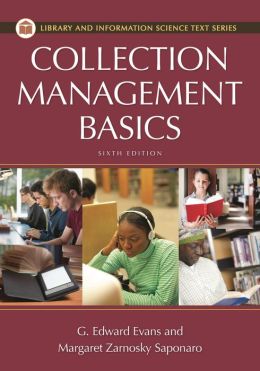
Collection Management Basics: Book Review

The Book
Barnes & Noble


Collection Management Basics (Sixth Edition)
G. Edward Evans
Margaret Zarnosky Saponaro

The Review


For the most part, the readings in this text were assigned in chronological order, so my professor did not feel that the issues present in the Gregory text were founded in this book. Still, this text was relegated as a supplement to our readings from the other textbook, which was the primary text for the class.

The Collection Management Basics has the look and feel of a traditional textbook. It also reads like one, making for dense chapters that approach 30 pages each. As such, this textbook was very informative but not the most pleasant reading material.

The Citation


Evans, G. E., Saponaro, M. Z. Collection management basics. 6th ed. Denver, Colorado: Libraries Unlimited.

Thursday, May 2, 2013

Collection Development and Management: Book Review

The Book

Collection Development and Management for 21st Century Library Collections: An introduction
Vicki L. Gregory

The Review

My professor decided to begin the course with chapters 4 and 5 of this text before going back to chapters 1-3. Her rationale was that we would need to have some basic knowledge of the Selection (4) and Acquisitions (5) process before assessing the needs of users (2). This makes a great deal of sense. Most textbooks begin by defining crucial terms and then build on the basic concepts, this text assumes that the reader brings a fairly high level of experience with Collection Management (which includes selection) and Acquisitions with them. While I did have a vague sense of what it was, I have a much more solid knowledge of the process now. The difference between collection management and acquisition in the library setting is as follows:
Collection Management
The process of selecting materials the library should hold.
Acquisition
The physical process involved in actually obtaining the selected materials.

Other than that one issue with the content order, this book was the main text for the course LIS 6511: Collection Development and Maintenance. It was a smooth read and very well supported with documented resources. Chapters hover around 20 pages in length, so they were not too long yet they presented substantial information. This was overall an excellent textbook.

Citation

Gregory, V. L. Collection development and management for 21st century library collections: An introduction. New York: Neal-Schuman.

That Time of the Semester


A Semester Has Ended


Since this semester is basically over, I'm going to have a lot of material to post. I will be posting about my overall experiences with Collection Development and Maintenance and Web Design for Librarians. First, I will review the textbooks that we used in the courses:
  • Collection Development and Management for 21st Century Library Collections by Vicki L. Gregory
  • Collection Management Basics by G. Edward Evans and Margaret Zarnosky Saponaro
  • Basics of Web Design by Terry Felke-Morris
I understand that reviewing textbooks sounds a little less interesting than watching paint dry, so I understand if nobody cares to read these next few posts.

Sunday, March 3, 2013

Blimey! Are we going metric?

Think Metric! By Franklin M. Branley [c1972]

Weeding

USF mug, FIU sweater.
USF mug, FIU sweater. (Photo credit: CMJimenez)
Every librarian should have some experience with the term. As a library student, I just turned in an assignment where I was to de-select 10% of a library's collection and then spend $3,000 on new materials for the collection (I had to drive from Miami to Tampa for a class in order to turn it in. See image to the right for proof of caffeine). I must say, it was fun to do traditional librarian duties in a real-world setting.

The Metric System is Coming!

We have all heard about some crazy books. This blog is no Awful Library Books, but this one has got to be the worst that I found in the collection. It warns that the metric system is about to invade the United States (kinda like the way the British Invasion influenced our music) and we should get used to measuring everything by the metric system.

Is the Metric System Superior?

Now, I'm not writing this to answer any question about the superiority of the metric system, this is a library blog after all. A better question for my purposes is: This book predicted that the metric system is taking over, has it?

Clearly, we still measure distance in miles and size in inches and feet. We are forty years removed from the publication of this title (making it older than I have been on this planet--yes, I will enjoy saying it every time I get the chance to) and we still have not seen the metric invasion.

Will we see it sometime in the future? Perhaps. However, I do not feel that the United States is on the verge of conversion. Therefore, we do not need to hold this outdated title in the collection.

Do you agree with my decision, or do you think the piece should have stayed? Let me know in the comments section!
Enhanced by Zemanta

Wednesday, December 26, 2012

Dreaming of Springtime


What else would you do the day after Christmas? I'm keeping warm with thoughts of Web Design & Collection Development. Here's the official description of what my life will be like until April. (This semester has already wrecked one weekend, we'll see how extensive the damage will end up being.)

LIS 5937 Web Design for Libraries (3) This course will provide the student with an
introduction to Web Design basic including theory, concepts and techniques. Topics will
include best practices, structure, layout, style sheets, graphics, publishing, templates,
software, and other web applications. After this course the learner will be able to:

  • Research, evaluate and describe the considerations regarding usability, accessibility, navigability, cultural sensitivity, global issues, and good design practices for websites in an instructional and informational resource environment.
  • Create and modify web page elements using various web and graphic creation tools for appropriate layout and design objectives.
  • Research and analyze current web design issues, elements, and considerations.
  • Create a web site employing good design principles and using appropriate content for an instructional and information resource environment.
  • Understand the use of graphic representations.
LIS 6511 COLLECTION DEVELOPMENT AND MAINTENANCE (3) Developmental
approach to building library collections of both print and non-print materials. Emphasis
upon evaluation, selection, and acquisition of library materials as they uphold the
objectives of the institutions for which they are selected and acquired.

© Christopher Jimenez. Powered by Blogger.
Related Posts Plugin for WordPress, Blogger...